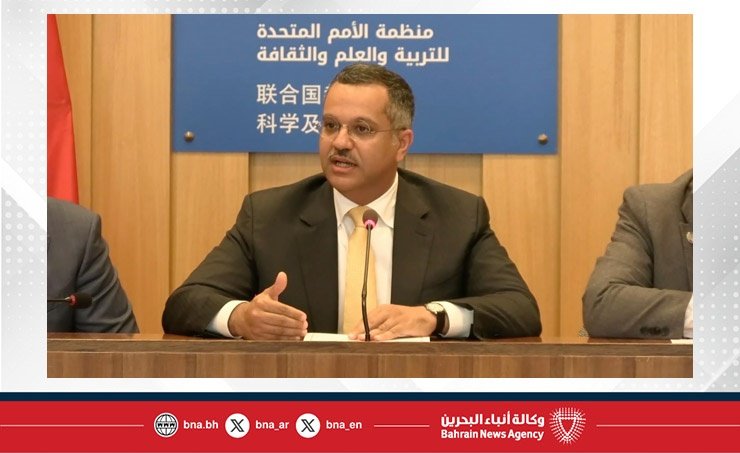
Paris, July 9 (BNA): A special seminar was held at the headquarters of the United Nations Educational, Scientific and Cultural Organisation (UNESCO) in Paris to mark the 20th anniversary of the inscription of Qal’at al Bahrain – Ancient Harbour and Capital of Dilmun – on the World Heritage List. The event was organised by the Bahrain Authority for Culture and Antiquities (BACA) on the sidelines of the 47th session of the World Heritage Committee. The seminar was attended by Shaikh Khalifa bin Ahmed bin Abdullah Al Khalifa, President of BACA; Essam Abdulaziz Al Jassim, Ambassador of the Kingdom of Bahrain to the French Republic; and Ernesto Ottone Ramírez, UNESCO Assistant Director-General for Culture. The event formed part of Bahrain’s national efforts to raise international awareness of Qal’at al Bahrain as an exceptional archaeological site and a living testament to successive civilisations on the land of the Kingdom of Bahrain, the heart of the ancient Dilmun civilisation. The seminar also highlighted major archaeological discoveries at the site, achieved through the work of Bahraini excavation teams and international missions, particularly the French archaeological mission. Shaikh Khalifa bin Ahmed bin Abdullah Al Khalifa said that Qal’at al Bahrain was not only the first site in Bahrain to be inscribed on the World Heritage List, but also a powerful symbol of Bahrain’s ancient civilisation and cultural legacy. He noted that the site stands as evidence of successive civilisations, especially Dilmun, which played a central role in the region’s history. He emphasised Bahrain’s commitment to protecting and documenting this legacy for future generations, and praised UNESCO’s longstanding partnership in safeguarding the Kingdom’s cultural heritage.
The seminar included a presentation by Dr. Pierre Lombard, researcher at the French National Centre for Scientific Research (CNRS) and former head of the French archaeological mission in Bahrain. He reviewed the key historical phases of Qal’at al Bahrain and its longstanding role as a cultural and economic hub in the Gulf.
Dr. Lombard highlighted the significance of the archaeological discoveries and commended the collaboration between BACA and the French mission in documenting and preserving the site’s historical and architectural value. He described the site as a unique example of civilisational and commercial exchange across millennia.
Qal’at al Bahrain was inscribed on the UNESCO World Heritage List in 2005. It is the largest archaeological mound in Bahrain and contains a well preserved record of nearly 4,500 years of continuous human settlement, from around 2200 BCE to the present.
The site reflects the strength of the Dilmun civilisation and its successors, particularly in their strategic control over trade routes in the Gulf. Its historical value is further enhanced by monumental architecture, urban planning, and archaeological finds.
Adjacent to the site is the Qal’at al Bahrain Site Museum, inaugurated in February 2008 with funding from Arcapita. The museum was established to preserve the site's ancient character and document the succession of civilisations through artefacts recovered during excavation.
https://www.bna.bh/en/QalatalBahrainWorldHeritageinscriptionmarkedatUNESCOseminar.aspx?cms=q8FmFJgiscL2fwIzON1%2bDhSxgF%2bXzTShkoPAGp5VY%2fc%3d